
If you're about to have a session with me, you've been told to come here and listen to my Hypnosis Prep-Talk. The Prep-Talk explains the actual hypnotic process, and it's less than 10 minutes long. Getting rid of myths and misapprehensions is Step 1.
Introduction to Hypnosis
Introduction to Hypnosis for Neurodivergents
And it's always a good idea to do Trance Practice once or twice before a session
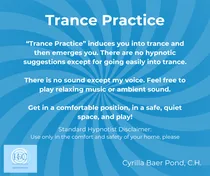
FREE DOWNLOAD
Don't have a session scheduled but found your way here while just browsing? Go ahead and have a listen anyway! You may get some of your questions answered - even questions you didn't know you had.
How Hypnosis Works
Science says "yes" — your mind really can do that.
I often call hypnosis the aspirin of therapies — we don’t fully know why it works, but we sure know that it does.
It’s not mind control, and it’s not pretending. Neuroimaging shows hypnosis is a real, measurable state — not just relaxation or imagination. fMRI studies reveal shifts in how the brain networks for focus and control (like the anterior cingulate cortex and dorsolateral prefrontal cortex) communicate. Those circuits reconfigure, creating a kind of deep, flexible concentration.
Meanwhile, connectivity between the parts that track “self” and the parts that initiate action quiets down — so hypnotic responses can feel automatic rather than deliberate, but the brain stays fully awake, aware, and in control; it’s just operating in a different configuration.
And yes, instruments pick up real physical changes. In one study, imagining a “cold glove” in hypnosis produced an actual drop in skin temperature, measurable in real time. Others show reduced pain activity, changes in heart rate, and shifts in immune response — all verified by sensors and scans.
Hypnosis doesn’t knock you out; it tunes your system. It’s the mind-body connection made visible, showing just how adaptable your neural wiring really is.
It’s not mind control, and it’s not pretending. Neuroimaging shows hypnosis is a real, measurable state — not just relaxation or imagination. fMRI studies reveal shifts in how the brain networks for focus and control (like the anterior cingulate cortex and dorsolateral prefrontal cortex) communicate. Those circuits reconfigure, creating a kind of deep, flexible concentration.
Meanwhile, connectivity between the parts that track “self” and the parts that initiate action quiets down — so hypnotic responses can feel automatic rather than deliberate, but the brain stays fully awake, aware, and in control; it’s just operating in a different configuration.
And yes, instruments pick up real physical changes. In one study, imagining a “cold glove” in hypnosis produced an actual drop in skin temperature, measurable in real time. Others show reduced pain activity, changes in heart rate, and shifts in immune response — all verified by sensors and scans.
Hypnosis doesn’t knock you out; it tunes your system. It’s the mind-body connection made visible, showing just how adaptable your neural wiring really is.
List of Studies Verifying Physical Changes in the Hypnotic State
- Stanford fMRI Study (2016) - https://med.stanford.edu/news/all-news/2016/07/study-identifies-brain-areas-altered-during-hypnotic-trances.html Brain scans showed reduced activity in dorsal anterior cingulate cortex, altered connectivity between prefrontal cortex and insula. 57 participants.
- Temperature Changes via MR Thermometry (2014) - https://pmc.ncbi.nlm.nih.gov/articles/PMC4063545/ Hypnotic "glove" suggestion produced measurable skin temperature changes in hand/wrist/forearm during fMRI scanning.
- Pain Network Suppression Study (2004) - https://www.sciencedirect.com/science/article/abs/pii/S1098733904005590 fMRI showed hypnosis reduced activation in primary sensory cortex, middle cingulate gyrus during thermal pain. Increased activity in basal ganglia/left ACC. 12 volunteers.
- Laser Pain Processing (2009) - https://pubmed.ncbi.nlm.nih.gov/19460446/ Thulium-YAG laser fMRI study: painful stimuli activated full pain network when awake but showed NO cerebral activation for identical stimuli during hypnosis. 13 participants.
- Fibromyalgia Pain Modulation (2008) - https://pubmed.ncbi.nlm.nih.gov/18653363/ fMRI showed hypnotic suggestions produced greater activation changes in pain-related brain areas (midbrain, cerebellum, thalamus, midcingulate, insula) vs non-hypnotic suggestions.
- Immune System Changes - T cells & B cells (1995) - https://pubmed.ncbi.nlm.nih.gov/8871356/ Flow cytometry analysis showed significant alterations in B-cells and helper T-cells in highly hypnotizable subjects exposed to hypnosis vs relaxation/control.
- Stress-Buffered Immune Response (2001) - https://news.osu.edu/hypnosis-may-prevent-weakened-immune-status-improve-health/ Medical students using self-hypnosis maintained stronger T-cell activity during exam stress vs controls. More practice = stronger immune response.
- Cytokine Expression Changes (2003) - https://pubmed.ncbi.nlm.nih.gov/12570090/ Blood samples showed hypnosis reduced proportion of T-cells expressing IFN-gamma and IL-2. Correlated with HPA axis mediators (ACTH, cortisol, beta-endorphin). 7 participants.
- Blood Pressure Reduction (2021) - https://pubmed.ncbi.nlm.nih.gov/34875965/ Randomized trial: 15-minute audio hypnotherapy significantly reduced systolic BP (p<.001) and stress levels vs control. 64 hypertensive patients.
- Heart Rate Variability Changes (2013) - https://pubmed.ncbi.nlm.nih.gov/23427840/ HRV measurements showed hypnosis decreased heart rate variability in women during session, with highest HRV post-hypnosis. Suggests cardiac and cognitive activation.
- Systematic Review - Brain Activity (2022) - https://pmc.ncbi.nlm.nih.gov/articles/PMC8773773/ Review of 40 studies using EEG, fMRI, PET: confirmed functional changes including reduced insula/ACC activity, altered theta waves, frontal activation patterns.
- Herpes Virus Recurrence (2002) - https://pubmed.ncbi.nlm.nih.gov/12186693/ Six weeks self-hypnosis training with immune imagery almost halved HSV-2 recurrence, improved mood, reduced depression/anxiety. Up-regulated NK cell activity.
FAQs
For Creative Professionals
For Fellow Neurodivergents
Why do I feel calm in rehearsal but freeze during auditions or performances?
That audition or performance freeze is a "panic switch" and happens when your brain links public judgment with danger. In hypnosis, we retrain that link so performing feels safe again. You learn to access your rehearsal calm even when the stakes rise.
Why do certain sounds make my body jolt or tense before I can think?
Those hyper-reactions to sounds are a way your nervous system jumps straight to a threat response. Hypnosis helps re-teach the body that a sound isn't danger. You build calm "space" around the trigger so it hits softer and fades faster.
Why do I forget my lines or blank out right when I need them most?
Line, music or choreography recall can be blocked by anxiety by over-activating the stress circuit that stores memories. Through hypnosis, you can rehearse relaxed focus until your brain associates performing with steadiness, not panic—so the words and actions return automatically.
How do I stop melting down so fast when overwhelmed by noise, light, or people?
I know it doesn't feel like it, but your meltdowns are your system working overtime to protect you. Hypnosis gives you internal switches to down-shift from overload into grounded calm, so you can regulate before burnout hits.
Why does creating feel like pressure instead of flow?
Perfectionism and self-criticism crowd out curiosity. Hypnosis quiets that inner noise and reconnects you to the playful, intuitive part of creativity so new ideas emerge again.
How do I stop replaying criticism or mistakes over and over in my head?
Criticism replays are loops your mind makes trying to finish an unfinished stress cycle. In hypnosis, we do a process where you look at your ruminations and label, assess & reassign them quickly and in a stress-free way, to break that cycle.
How can I loosen chronic tension without losing precision in my performance?
Chronic tension is often a subconscious "readiness to be judged." In hypnosis, you teach the body to move with precision and ease. Pain reduces, recovery improves, and your body becomes your instrument again. Hypnosis can also help you immediately access peak performance.
I mask all day to fit in and crash afterward—is there a way to rest without shutting down completely?
No one likes a shut down or crash, and hypnosis can absolutely help. Hypnosis builds a mental "safe room" where your body can drop the mask and decompress. Over time, you can unmask more safely and keep energy for what matters. I also teach a "whoosh" technique for handling surprise stress.
Why do I dread auditions even though I've prepared well?
Even thought you've prepared hard and thoroughly, your mind may still expect threat rather than opportunity. Hypnosis helps you rehearse emotional safety until audition settings trigger focus, confidence, and immersion in your art instead of fear.
How can I notice burnout before I collapse?
Hypnosis can be used to teach you bodily awareness - to track early body signals so you can reset before overload. You can become fluent in your own nervous system signals.
I have an audition coming up that is very important to me. What can I do to prepare beyond the usual?
Some auditions will be more important than others, so how do you get an edge for those? As a former performer myself, I work with actors to use hypnosis not only to present their auditions well, but to deeply prepare their character and to instantly create peak performance techniques for vocals, movement and dance - this gives you an edge that most other performers seldom consider.
When I try to sleep, my brain whirls with thoughts and ruminations. How can I get some sleep?
Sleep can be very challenging for those of us with differently wired brains, but hypnosis can quiet your busy mind and wind it down for sleep. I have a recorded session just for us neurodivergents that quickly goes through releasing those thoughts, preparing our sleeping space mentally, and then drifting into a healing sleep.
Why can't I remember choreography or music as easily anymore?
Memorization naturally gets harder - we not only get older, but we often are advancing to roles with more to learn. And stress and fatigue limit how memory encodes.
Hypnosis restores the calm, receptive state that supports learning, so recall and timing return.
Hypnosis restores the calm, receptive state that supports learning, so recall and timing return.
Can I manage misophonia without hiding or wearing headphones all day?
Misophonia is tough, but it can be tamed. While hypnosis won't erase triggers, it can train your body not to spike into alarm. I suggest learning Self-Hypnosis for this and - with my help - creating your own hypnotic suggestions to gradually diminish your reactions to triggers.
I've tried therapy and coaching, but this anxiety feels deeper-what else can help?
When conscious tools like therapy and coaching plateau, hypnosis comes in to work at the subconscious level where automatic reactions live. It blends easily with therapy or coaching to create faster, body-based change and I'm always very happy to work with your therapist/coach to get you the best outcomes between us.
Will this work if I think in words or logic or feelings, not pictures?
Some of us picture things, some of us sense or feel things. Hypnosis designed specifically for neurodivergent minds meets you where you are. We use your natural thinking style instead of forcing visualization. It's adaptable to every neurotype.
Why do I shake or get sweaty palms before I perform even though I know my material?
Performance jitters that cause shakes and sweats are from your nervous system getting stuck in threat mode. Hypnosis retrains your body's automatic response so physical symptoms quiet down and you can access your skills under pressure.
What actually helps with autistic burnout or ADHD overwhelm?
For neurodivergent burnout or overwhelm, hypnosis provides structured rest and focus retraining. Learning to calm your body and mind through hypnosis helps your system move between intensity and serenity so you can work with your brain's rhythms, not against
I feel disconnected or like I'm watching myself during performances—what's happening?
That's disconnection during performance is dissociation - it's your brain's way of escaping either overwhelming stress or the boredom of repeated performance. Hypnosis helps you stay present and grounded in your body so you can feel the performance instead of floating above it.
How do I stop listening for trigger sounds? My brain won't let go.
It's natural that your brain searches for trigger sounds because it's trying to protect you by hyper-monitoring for threats. Hypnosis teaches your nervous system that it's safe to release that vigilance, so you can be present without constant scanning.
How do I get into flow state or "the zone" more consistently?
Flow, or The Zone, happens when your conscious critic steps aside. Hypnosis trains you to drop into that receptive, focused state on command so you can access it whenever you perform. It can also naturally tune you into your personal peak performance
I feel disconnected from myself from masking so much - how do I find who I really am?
Self-exploration is easier with hypnosis, which creates a safe space to explore your authentic self without the performance layer. You gradually rebuild trust in your own needs, preferences, and identity. And when I use Ultra-Height Hypnosis, your exploration remains completely personal - you needn't share anything with me.
I avoid auditions completely now—how do I stop running away?
Audition avoidance is your brain protecting you from perceived danger. In hypnosis, we rewire that threat response so auditions become opportunities you can move toward instead of flee from.
Why do I snap at loved ones after holding it together all day?
"Losing it" when you get home after a tough day is restraint collapse. You've been regulating so hard in public that your system releases at home. Hypnosis helps you decompress gradually throughout the day so you don't hit that breaking point.
Why does criticism replay in my head for days afterwards?
Criticism replays are your mind trying to finish processing an emotional threat. Hypnosis teaches you to release that stress loop so your brain can finally let it go, and replace those feelings with those that make you feel calm, talented and secure.
Can anything help with executive function problems like planning, organizing, or starting tasks?
Executive Function is a problem for many of us, but luckily hypnosis can reduce the anxiety, overwhelm and perfectionism that freeze executive function. When your nervous system calms and you deeply accept that you don't have to do everything at once or perfectly, your ability to plan, prioritize, and initiate improves naturally.